1.5V LED FLasher Using 3 Transistors

To make LED works, you need a voltage source that is higher than the LED’s forward bias voltage, and it’s higher that 1.5V (around 2V for red LEDs). Fortunately, now you can make a LED flasher circuit that needs only 1.5V or a single cell battery to work. Here is the schematic diagram of the circuit:
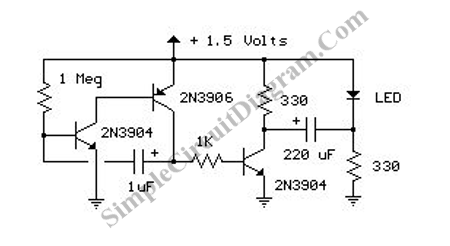
low voltage led flasher transistor circuit schematic diagram

The core of this LED flasher scircuit is a capacitor charge pump, to make a higher voltage.  You can see the final transistor driver is connected to a 330 ohm resistor. When this transistor is switched off, the 220uF capacitor is charged to 1.5V via two 330 ohm resistor. After the capacitor is full of charges, then when the transistor is switched on, the voltage acrros the LED is the supply voltage plus the capacitor voltage, or about 3V, and now the current will flow from the supply through the LED, capacitor, and transistor.

This entry was posted in Audio and Music, Lighting and LED Circuit and tagged . Bookmark the permalink.,

Possibly Related to "1.5V LED FLasher Using 3 Transistors" Circuits

  • LED Flasher Using Transistor
    This simple LED flasher circuit will turn ON and OFF two LED alternatively. The first LED will turn ON when the second LED is OFF for some period, then the first led will turn OFF and the second LED will … Continue reading →...
  • 555 IC LED Flasher for Up To 10 LEDs
    This LED flasher circuit uses 555 IC, and is capable of driving up to 10 LEDs. The good news is, the use of multiple LEDs in series doesn’t increase the power consumption when compared with using only two LEDs. If … Continue reading →...
  • Led Flasher Circuit Using 555 IC
    LED flasher circuit can be built based on 555 IC. Using 555 IC, the flashing rate can be more flexible to adjust.  This LED flasher circuit is similar to our transistor flasher circuit, but the flashing period of both LEDs … Continue reading →...
  • Brightness Control for Multiplexed LEDs
    To add PWM intensity control to connected LEDs, a switched-LED power supply approach can also be used. A circuit using a PWM-based supply to provide additional intensity control to some LEDs is shown on figure below. The PWM waveform and … Continue reading →...
  • Small Amplifier Using Transistors
    The output of this circuit is push-pull and consumes less than 3mA (with no signal) but drives the earpiece to a very loud level when audio is detected. Because the whole circuit is Dc coupled, its extremely difficult to set … Continue reading →...

Comments are closed.