Power Amplitude Modulator

We can use L200 to send a signal onto a supply line. We can define Vo as Vo = Vref (1+ R2/R1)  since the input signal Vi is DC decoupled.
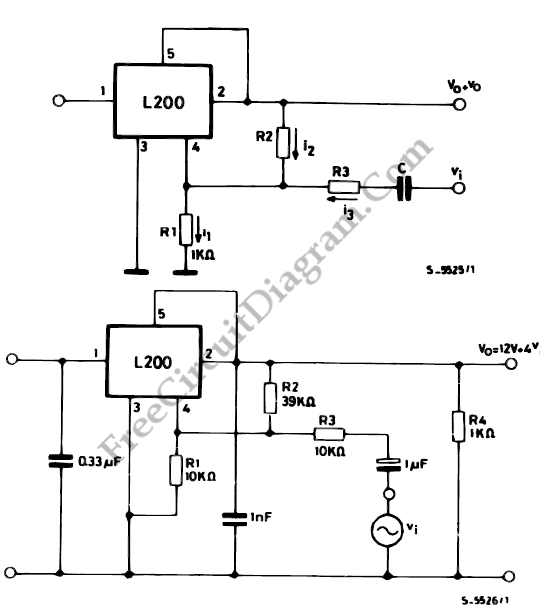
Power Amplitude Modulator circuit schematic diagram

The gain of amplified signal is:

Gv= -R2/R1

This amplified signal is added to this component. We must impose i1 = i2+i3 (1) by ignoring the current entering pin 4.

Equation (1) becomes

i2= -i3 with i3 = Vi/R3 (for Xc<<R3)

Vo=R2 i2= -(Vi/R3).R2

since the voltage between pin 4 and ground remains fixed (Vref) as long the device is not in saturation, i1=0.

An application is shown in circuit diagram below. R1 should be replaced by a potentiometer if the DC level is to be varied but not the AC gain. [Source: STMicroelectronics Application Note]

This entry was posted in Power Supply and tagged . Bookmark the permalink.,

Possibly Related to "Power Amplitude Modulator" Circuits

  • Amplitude Modulator with OTA
    Circuit described in the schematic diagram below can achieve 99% modulation easily with maximum frequency of 200kHz. The amplification of this circuit can be controlled easily since the transconductance of an operational transconductance amplifier is directly propotional to the control … Continue reading →...
  • Programmable Current and Voltage Regulator for Battery Charger
    This is a programmable current and voltage regulator circuit. It consist of a voltage regulator with external current limitation. The variable resistor R2 is forced by a constant current because of the fixed voltage of 2.77 V at the terminals … Continue reading →...
  • Power Control: Synchronization by The Mains Voltage
    On the circuit diagram below show us a schematic of step-down circuit which is used to approximately divide by two the rms voltage between the line input and the inductive load (L1). C2 and R3 give a turn-on delay of … Continue reading →...
  • L200 DC Motor Speed Control
    This diagram tells us about how to use L200 device for the speed control of permanent magnet motors. By means of R1 and R2, we can obtain the desired speed, proportional to the voltage at the terminal of the motor. … Continue reading →...
  • Pulse Position Modulator Using 555 IC
    Pulse position modulation is similar to pulse width modulation, but the frequency is not constant.  Like pulse width modulator circuit, pulse position modulator can be easily constructed using 555 IC.  Here is the schematic diagram of the circuit: If you … Continue reading →...

Comments are closed.