Digital Transmission Isolator

Digital transmission isolation is important for keeping the digital noise to reach the analog path, that’s the benefit for noise isolation. For electrical isolation, isolating the signal after digitizing is often easier since digital signal is inherently nonlinear, no need for linear device to transfer.  You can use the following circuit for many purpose:
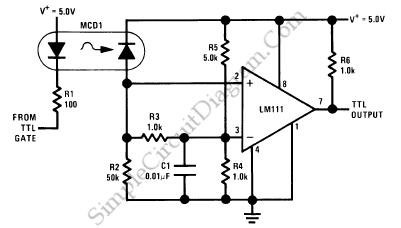
Digital Transmission Isolator circuit schematic diagram

[Source: National Semiconductor Application Note]

This entry was posted in Signal Processing and tagged . Bookmark the permalink.,

Possibly Related to "Digital Transmission Isolator" Circuits

  • Precision Photodiode Comparator
    This photodiode signal conditioning circuit is sensitive to light signal, suitable for interfacing digital serial signal. The biasing of the LM111 noninverting input is matched to the diode’s dark output, so it should be very sensitive. [Source: National Semiconductor Application … Continue reading →...
  • Digitizing a LVDT Transducer Interface Output
    Digitizing transducer interface output voltage is shown on circuit diagram below. The transducer in this case is the NE5521, an LVDT (Linear Variable Differential Transformer) Signal Conditioner. To ensure that the input to the A/D does not go excessively beyond … Continue reading →...
  • FSK Demodulator Using LM565
    The FSK demodulator is the electronics device that converts the FSK signal to serial digital signal. To transmit digital serial data we use FSK modulation and to get back the digital data at the receiver, we need to demodulate it. … Continue reading →...
  • 2.5KV Isolated RS232-TTL/CMOS Converter/Driver/Receiver
    The ADM3251E is a transceiver which has a high speed, 2.5 kV fully isolated, single channel RS-232/V.28. This device is operates from a single 5 V power supply. The device is ideally suited for operation in electrically harsh environments or … Continue reading →...
  • Detector for Magnetic Transducer
    Magnetic transducer is usually found in pulse counting application, and we can use this circuit to amplify and convert the signal from the transducer.  Here is the schematic diagram of the signal conditioning circuit: [Source: National Semiconductor Application Note]...

Comments are closed.