Two Transistors Lead Acid Battery Monitor

The circuit of battery monitor below uses 3 separate LEDs. Voltage level between 6v to below 11v will turn the red LED on and will turn off above 11v. Between 11v and 13v will turn the orange LED on and will turn off above 13v. The green LED illuminates above 13v.
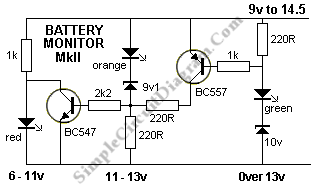
Two Transistors Lead Acid Battery Monitor circuit schematic diagram

[Source: talkinglelectronics.com]

This entry was posted in Power Supply, Test and Measurement and tagged . Bookmark the permalink.,

Possibly Related to "Two Transistors Lead Acid Battery Monitor" Circuits

  • Single Transistor Lead Acid Battery Monitor
    Using a dual-colour LED and few surrounding components, we can make a very simple battery monitor. This battery monitor circuit is suitable forĀ  monitoring your car battery, enrich your dashboard with cool and functional accessory. Orange colour is produced by … Continue reading →...
  • Simple Battery Monitor
    When battery voltage drops to a certain level set by 10k pot, this simple battery monitor circuit energizes a LED. For reading battery voltage in 1 V steps or even steps as small as 0.1 V, we can add any … Continue reading →...
  • Lead Acid Battery Charger Circuit
    To charge lead-acid batteries we can use this circuit that consist of a current-limited power supply and a flyback converter topology. Here is the schematic diagram of the circuit : Isolation and voltage input range flexibility are provided by the … Continue reading →...
  • BQ24105 Switch Mode Lead Acid Battery Charger
    Switch mode circuits can implement the lead acid battery charger with a more efficient. It can be constructed using bq24105 battery charger controller. The bq24105 was originally designed to charge single-, two- or three-cell Li-polymer and Li-ionĀ  battery packs. The … Continue reading →...
  • Sealed-Lead Acid Battery Charger
    To optimally control the charge and hold cycle for sealed lead acid battery, UC2906 series of battery charger controllers is used by all of the necessary circuitry. These integrated circuits control and monitor both the output voltage and current of … Continue reading →...

Comments are closed.