Posts Tagged ‘Switching Regulator’
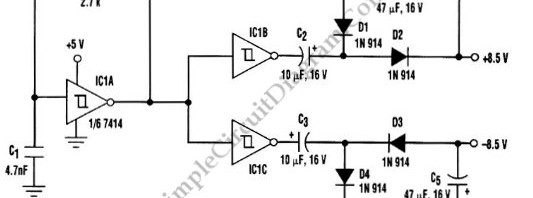
This is a voltage multiplier circuit. First circuit is used to double the a square wave (any amplitude). However there is minus about 2v losses in base-emitter of the transistors and the diodes in first circuit.
To work, second circuit must fall to nearly 0.4v and rise to at least 5.6v. to prevent short-circuiting and both …
Read MoreThis is a circuit of Paralleling devices using MAX1044. This circuit can be used to increase current capability and reduce output resistance. In this circuit capacitor C1 is used as pump and C2 used as reservoir that serves all devices. Here is the circuit :
The output resistance is defined by following equation :
Rout=Rout of MAX1044 …
This is a Combined Positive Multiplication and Negative Voltage Conversion circuit, a popular application for MAX1044/ICL7660. Here is the circuit:
This circuit can provides both negative and positive voltage. TO provide negative voltage, this circuit uses C3 and C1 which perform the reservoir and bucket. To generate the doubled positive voltage, the C4 and C2 are …
Read MoreThis is a circuit of Cascading Devices using MAX1044/ICL7660. This circuit can provide Larger negative multiples of the supply voltage. The resistance of first that multiplied by the quiescent current of the second, etc will reduce the output voltage. The devices that can be cascaded is not only two devices but also three or more …
Read MoreThis is a simple circuit of Positive Voltage Doubler. This circuit uses the MAX1044/ICL7660. The schottky diode was chosen to reduces the voltage drop. This circuit also uses MAX660 for voltage doubling or higher output currents. Here is the circuit:
[Source: Maxim Application Note]
Read MoreThis is a Negative Voltage Converter circuit. This is the most popular application that use the MAX1044/ICL7660. This circuit just requires two external capacitors. It is recommended if the circuit is added by A third power-supply bypass capacitor with value range 0.1µF to 10µF. Here is the circuit :
[Source: MAXIM Application Note]
Read More