Discrete Overvoltage Protector for Automotive Application

This is a circuit of discrete overvoltage protector for automotive application. There are two basic thing that must be done by protection circuit. They are prevent voltages greater than the maximum allowable from being applied to the IC pins and the protection circuit not to intrude on the normal function of the circuit. Beside that, it must be fast enough to act on any transient events. Here is the schematic diagram of discrete overvoltage protector circuit :
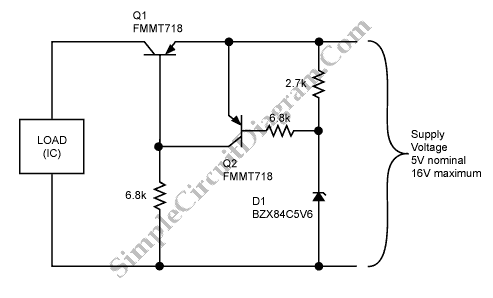
Discrete Overvoltage Protector for Automotive Application1 circuit schematic diagram

The PNP transistor Q1 is the main pass element of this circuit. The characteristics of this transistor will determine any power-supply voltage drops. A Zetex FMMT718 is used to minimizes the voltage drop induced by the presence of the protection circuit. As the control element for Q1, this circuit use transistor Q2, when the voltage at the power-supply input is equal to the sum of the zener voltage Q2 will turn on and turning off Q1. A typical trip voltage that is produce byD1 and Q2 is  5.85V. To keep Q1 turned on under normal circumstances, the 6.8k resistor connected to the base of Q1 by producing the current.

During overvoltage conditions, the load is disconnected by this circuit. When the overvoltage conditions is detected, the Q1 will turn off and remove power from the load, it will turn on when the conditons back to normal. The response speed of this circuit is one of the attractions of this circuit because it does not use feedback, so there are no slew-rate limitations to overcome or high-order damping effects. There are no  special requirements of Q2 and almost any PNP device could be replaced but Q2 should have the same type as Q1. [Source: maxim-ic.com]

This entry was posted in Power Supply and tagged . Bookmark the permalink.,

Possibly Related to "Discrete Overvoltage Protector for Automotive Application" Circuits

  • Transistor Overvoltage Crowbar Protector
    This is a transistor crowbar circuit for overvoltage protection. This circuit is used to protect any devices, when the overvoltage occurs. This circuit consist of diode, transistor, and resistor, and a fuse.  The device that needs to be protected should … Continue reading →...
  • MAX6495 Overvoltage Limiter
    To protect downstream circuits from overvoltage conditions that show up during load-dump events or transients, we can use the MAX6495–MAX6499/MAX6397/MAX6398 overvoltage protection (OVP) devices. Here’s the circuit diagram: This devices work by controlling an n-channel MOSFET wired in series with … Continue reading →...
  • Overvoltage Protection with LT1018
    Sometimes, the regulator does not work well so the regulator generate overvoltage that will destroy the system. To prevent system damage, a overvoltage protection circuit should be used. The overvoltage occurred when the regulator connects the raw DC supply to … Continue reading →...
  • Discrete R/S Flip Flop
    This circuit is an example of a set/reset flip flop. Set/reset flip flop is the simplest flip flop. This circuit using discrete components. Here is the schematic diagram : When this circuit obtain the power, only one of the transistors … Continue reading →...
  • Crowbar Power Supply Overvoltage Fault Protector
    This is a The Crowbar circuit. This circuit is used to prevent the load from damaging. This circuit utilize a zener diode. The regulator steps down the 12V input to 5V. The load will damage when the regulator is fail … Continue reading →...

Comments are closed.