FET Op Amp

THE FM3954 monolithic-dual gives us an ideal low-offset and acts as low-drift buffer function for the LM101A op amp. Track over it’s bias current range thus improving common mode rejection is the excellent matching characteristics of the FM3954.

Here’s the circuit diagram:
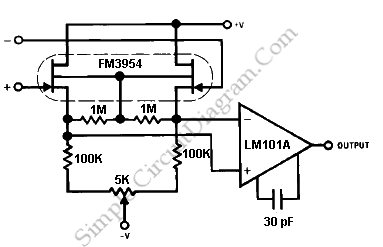
FET OP Amp circuit schematic diagram

[Source: National Semiconductor Application Note]

This entry was posted in Signal Processing and tagged . Bookmark the permalink.,

Possibly Related to "FET Op Amp" Circuits

  • Op-Amp Application: Unity Gain Buffer
    This circuit is an Unity Gain Buffer. This circuit has a highest input impedance of any OP-AMP circuit. This circuit has a less gain error that is equal to common mode rejection or the reciprocal of the amplifier open-loop gain. … Continue reading →...
  • Op-Amp Application: Level Shifting Amplifier
    Sometimes, in linear equipment design, it’s necessary to take a voltage which is referred to some dc level and generate an amplified output which is referred to ground. Using a differential amplifier similar to that shown in the circuit diagram … Continue reading →...
  • Micropower Single-Supply Instrumentation Amplifier
    A schematic diagram of a micropower single-supply instrumentation amplifier circuit is shown below. This circuit only need 15µA of current and can give over 110dB of common rejection. A single amplifier can provide differential to single-ended conversion with excellent common … Continue reading →...
  • Op-Amp Application: Inverting Amplifier
    The figure below show an operational amplifier circuit. Closed-loop gain given by this circuit is R2/R1 when this ratio is small compared with the amplifier open-loop gain, and it’s called as inverting circuit. The value of input impedance is equal … Continue reading →...
  • Differential TMP01 Temperature Sensor Transmitter
    This is a TMP01 Temperature Sensor Transmitter circuit. This circuit is used in industrial environments to transmit the signal differentially on a wire pair due to noisy industrial environments. This circuit will reduce errors significantly. Here is the schematic diagram … Continue reading →...

Comments are closed.