6th Mar 2010 | Comments Off
This is high frequency switch circuit. This circuit uses the 2N4391. When it is off, it will provide a high off-impedance (<0.2pF) and low on-resistance of 30 ohm. Here is the circuit :
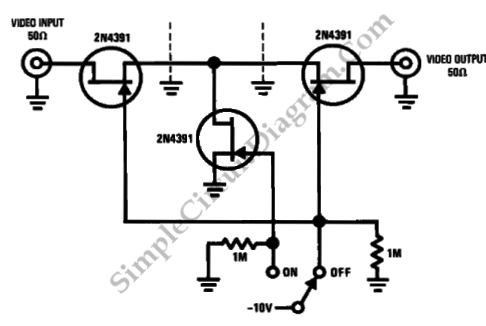
This circuit has attenuation > 80dB @ 100 MHz and insertion loss about 6 dB. It can be immediately achieved if we use an “ideal” switch and proper layout. [Source: National Semiconductor Application Note]
Possibly Related Circuits
- Discrete High Current Switch Mode LED Driver
This is a discrete high current switch mode LED driver circuit. The basics of this circuit is a buck-converter principle. The efficiency of this circuit is 80 to 90 %. This circuit can be applied on automotive lighting applications. The advantages of this circuit are low component and low cost.... - Dimmer Switch, General Purpose Electric Power Control
Dimmer Switch Introduction Dimmer switch can be used to replace your electrical switch for lamps, heaters, or some types of electric motor. Dimmer switches will control the electricity not only for on-off operation, but they are capable of operating somewhere between “on” and “off”. Dimmer switch actually works by switching... - FET Op Amp
THE FM3954 monolithic-dual gives us an ideal low-offset and acts as low-drift buffer function for the LM101A op amp. Track over it’s bias current range thus improving common mode rejection is the excellent matching characteristics of the FM3954. Here’s the circuit diagram: [Source: National Semiconductor Application Note] ... - High Frequency Function Generator Using MAX038
Function generator ranging from 0.1 Hz to 20 MHz can be easily built using MAX038 integrated circuit chip. Here is the most simple implementation of high frequency sine wave generator, and you can easily modify it to generate square wave, or triangle waveform. Here is the schematic diagram of the... - Switch Mode Regulator Provides -12V Negative Supply from Positive Supply
This is a circuit that can provide -12 V negative supply from positive supply. The output voltage is Vo= -Vin· D/(1-D). The maximum output current is Iout=1·(1-D). Here is the circuit : In this circuit, the ground of U1 is connected to negative output voltage. The input voltage of U1...
Search Terms:
cacheCategory: Signal Processing
Tags: Video