Positive Voltage Doubler

This is a simple circuit of Positive Voltage Doubler. This circuit uses the MAX1044/ICL7660. The schottky diode was chosen to reduces the voltage drop. This circuit also uses MAX660 for voltage doubling or higher output currents. Here is the circuit:
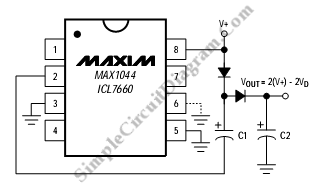
Positive Voltage Doubler circuit schematic diagram

[Source: Maxim Application Note]

This entry was posted in Power Supply and tagged . Bookmark the permalink.,

Possibly Related to "Positive Voltage Doubler" Circuits

  • Combined Positive Multiplication and Negative Voltage Conversion
    This is a Combined Positive Multiplication and Negative Voltage Conversion circuit, a popular application for MAX1044/ICL7660. Here is the circuit: This circuit can provides both negative and positive voltage. TO provide negative voltage, this circuit uses C3 and C1 which … Continue reading →...
  • Cascading MAX1044/ICL7660 Voltage Doubler Devices
    This is a circuit of  Cascading Devices using MAX1044/ICL7660. This circuit can provide Larger negative multiples of the supply voltage. The resistance of first that multiplied by the quiescent current of the second, etc will reduce the output voltage. The … Continue reading →...
  • Paralleling MAX1044 Devices
    This is a circuit of Paralleling devices using MAX1044. This circuit can be used to increase current capability and reduce output resistance. In this circuit capacitor C1 is used as pump and C2 used as reservoir that serves all devices. … Continue reading →...
  • Negative Voltage Converter
    This is a Negative Voltage Converter circuit. This is the most popular application that use the MAX1044/ICL7660. This circuit just requires two external capacitors. It is recommended if the circuit is added by A third power-supply bypass capacitor with value … Continue reading →...
  • Switch Mode Regulator Provides -12V Negative Supply from Positive Supply
    This is a circuit that can provide -12 V negative supply from positive supply. The output voltage is Vo= -Vin· D/(1-D). The maximum output current is Iout=1·(1-D). Here is the circuit : In this circuit, the ground of U1 is … Continue reading →...

Comments are closed.