INA159 Dual-Polarity, Bidirectional Current-Shunt-Monitor Circuit

Sponsored Links

This is a INA159 Dual-Polarity, Bidirectional Current-Shunt-Monitor Circuit. This circuit uses OPA340 because it has near rail-to-rail input and output swing ranges that allow the output voltage of the circut to approach 0 and 5V. The gain of OPA340 is set to +100 and the INA159 gain is +0.2V/V. This circuit has gain of +20V/V. Here is the circuit :
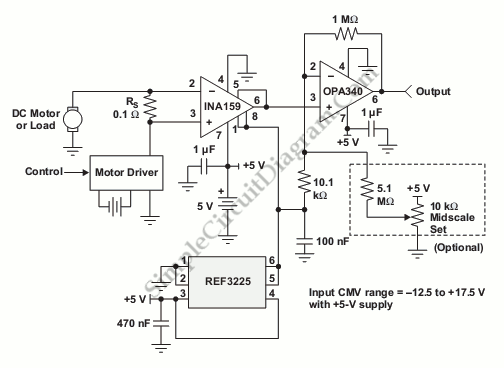
INA159 Dual-Polarity, Bidirectional Current-Shunt-Monitor Circuit

To increase the sensitivity we can use a higher OPA340 closed-loop gain. However, it will increase DC errors and reduces the bandwidth if we use a higher OPA340 closed-loop gain. The output of INA159 can be increased by increasing the value of shunt resistor Rs from 0.1 ohm to a larger value. However we must evaluate the consequences of higher resistor power dissipation and the larger voltage drop. [Source: Texas Instruments Application Note]

This entry was posted in Control Electronics, Test and Measurement and tagged . Bookmark the permalink.

Possibly Related to "INA159 Dual-Polarity, Bidirectional Current-Shunt-Monitor Circuit" Circuits

Sponsored Links
  • Op-Amp Application: Inverting Amplifier
    The figure below show an operational amplifier circuit. Closed-loop gain given by this circuit is R2/R1 when this ratio is small compared with the amplifier open-loop gain, and it’s called as inverting circuit. The value of input impedance is equal … Continue reading →...
  • Op-Amp Application: Non-Inverting Amplifier
    This is a high input impedance non-inverting circuit. This circuit provides a closed loop gain equal to (R1+R2)/R1. The close-loop 3 dB bandwidth of this circuit equal to the amplifier unity-gain frequency divided by the closed-loop gain. Here is the … Continue reading →...
  • Precision Current Source
    This is a circuit of precision current source. This circuit uses two kinds of transistor, the 2N2219 bipolar and the 2N3069 JFET. Both of them are used as voltage devices between the current sensing resistor and the output. As the … Continue reading →...
  • Self Powered Current Sensing
    This is a current sensing circuit that senses the current at the high side (between load and positive supply). This circuit     take advantage from Rail-to-Rail input of the LT1494 and the microampere supply current. Here is the circuit : At … Continue reading →...
  • Ultrasonic Proximity Detector
    This is ultrasonic proximity detector circuit. This circuit consist of micropower opamp and a pair of matched piezo-ceramic tranducers. It uses a 9V battery as power supply. This circuit uses the radar principle, when the objects or people is nearby … Continue reading →...

Comments are closed.