Detector for Magnetic Transducer

Magnetic transducer is usually found in pulse counting application, and we can use this circuit to amplify and convert the signal from the transducer.  Here is the schematic diagram of the signal conditioning circuit:
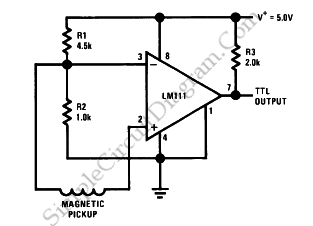
Detector for Magnetic Transducer circuit schematic diagram

[Source: National Semiconductor Application Note]

This entry was posted in Signal Processing, Test and Measurement and tagged . Bookmark the permalink.,

Possibly Related to "Detector for Magnetic Transducer" Circuits

  • Digitizing a LVDT Transducer Interface Output
    Digitizing transducer interface output voltage is shown on circuit diagram below. The transducer in this case is the NE5521, an LVDT (Linear Variable Differential Transformer) Signal Conditioner. To ensure that the input to the A/D does not go excessively beyond … Continue reading →...
  • Magnetic-Pickup Phono Preamplifier
    This is a simple circuit of magnetic pickup phono preamplifier. A proper loading to a reluctance is provided by this circuit. Here is the circuit: The gain provided by this circuit is approximately 25dB at 1kHz (2.2mV input for 100mV … Continue reading →...
  • Precision Photodiode Comparator
    This photodiode signal conditioning circuit is sensitive to light signal, suitable for interfacing digital serial signal. The biasing of the LM111 noninverting input is matched to the diode’s dark output, so it should be very sensitive. [Source: National Semiconductor Application … Continue reading →...
  • Precision Squarer
    Squarer circuit is used to shape signal, to get more defined square wave. This circuit is useful to make convert the signal so it has very fast rise time. Here is the schematic diagram of the circuit: [Source: National Semiconductor … Continue reading →...
  • Pulse Width Modulator Using 555 IC
    A very simple pulse modulator circuit can be built using 555 IC. In 555 chip, a special modulator input is available at pin 5. Here is the schematic diagram of circuit: This pulse modulator circuit need an external clock signal … Continue reading →...

Comments are closed.