Single Cell LED Flashlight
This is Single Cell LED Flashlight circuit. This circuit uses white LED that has best power-efficiency combination at about 20mA and requires abut 3.3V. Each Led in this circuit draws power about 66mW. This circuit uses seven LEDs. This circuit very useful for a tiny pocket flashlight because the whole array of leds run at close to one half watt. The Leds are arranged in series, to prevent having to control the current separately for each LED. This circuit can provide about 23V at 20mA, when fed from a 1.5V alkaline cell or from a 1.2V NiMH rechargeable cell. The advantages of this circuit are efficient, low cost, reliable and simple. Here is the circuit:
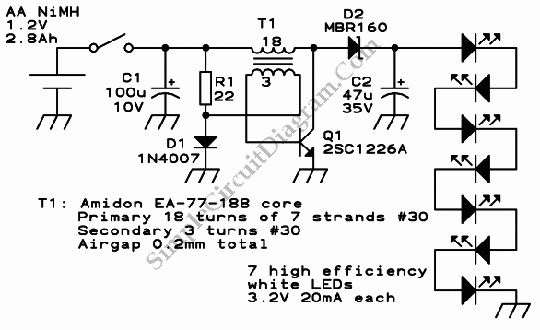
This circuit is a self-oscillating boost converter. When it is ran, all components except the LEDs staying completely cold to the touch. This circuit uses transistor, the 2SC1226A, that is very old and rare part. The transistor can save some space, because it has a soft, thin copper tab which can easily be cut off.
The transistor can be replaced by another transistor that has this characteristic : a maximum continuous current of about 3A, have a breakdown voltage of about 40V, be reasonably fast, have good saturation characteristics, and have a reasonably high hfe (at least 30, ideally about 100) at a current of 1A. If the transistor is replaced by the another transistor, the value of R1 should be changed, to set the proper power level for the LEDs. To determine the value of R1, a milliamperemeter can be placed in series with the LED string, and selecting the resistor for 20mA in the LEDs. The resistor should be a bit higher, if the circuit is used for an alkaline cell. [Source: Homo Ludens Electronicus]