Voltage Multiplier

This is a voltage multiplier circuit. First circuit is used to double the a square wave (any amplitude). However there is minus about 2v losses in base-emitter of the transistors and the diodes in first circuit.
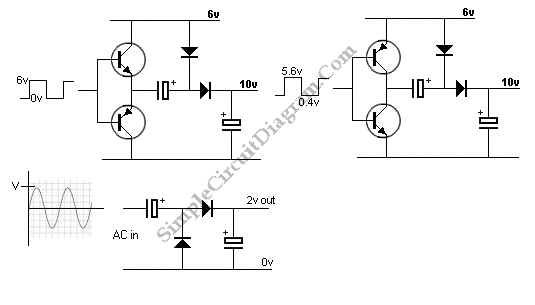
VOLTAGE MULTIPLIER circuit schematic diagram

To work, second circuit must fall to nearly 0.4v and rise to at least 5.6v. to prevent short-circuiting and both transistors coming on at the same time, the rise and fall times must be very fast. The third circuit is used to double an AC voltage. The AC voltage rises “V” volts below the 0v rail and “V” volts above the 0v rail. [Source: talkingelectronics.com]

This entry was posted in Power Supply and tagged , , . Bookmark the permalink.,

Possibly Related to "Voltage Multiplier" Circuits

  • 5V FET Voltage Regulator and How It Works
    Using a FET and two additional transistors (cascaded to improve the gain), a 5V FET voltage regulator can be formed. The additional Tr2 and Tr3 transistors will improve the output current handling and decrease the output impedance. The output voltage … Continue reading →...
  • Small Amplifier Using Transistors
    The output of this circuit is push-pull and consumes less than 3mA (with no signal) but drives the earpiece to a very loud level when audio is detected. Because the whole circuit is Dc coupled, its extremely difficult to set … Continue reading →...
  • Voltage Regulator with Op-Amp and Transistors
    With feedback, we can do very much better and achieve a nearly perfect voltage source. We can see this principle which is shown in the circuit below. Using a voltage divider on the output or the voltage reference, the output … Continue reading →...
  • 1.5V Micropower CMOS Voltage Regulator
    The LP3992 is Micropower CMOS Voltage Regulator with input range of 1.9 to 5.2V and can produce 1.5V output. This regulator suits for application that need an accurate output voltage with power from battery, low quiescent current, low noise and … Continue reading →...
  • Variable Voltage Reference
    A positive variable voltage reference circuit is shown in the schematic diagram below. A voltage reference can be made using a zener diode, but this method produce a fix reference value. To make a variable reference, we can amplify the … Continue reading →...

Comments are closed.