PMOS FET Following The Output for Soft-Start Mechanism

Using the following PMOS FET switch regulator output, in series with the regulator’s load as shown in the picture below is the most simple method. Switch placement should really be noted. To ensure that the regulator remains stable, the switch should be placed after regulators required minimum output capacitance (ie, C3). After regulators suddenly lit, FET Q1 operates as a crude supervisors and pulled low RT. Capacitor CT, effective replace the gate-to-drain capacitance of the FET, and then cause the switch to function as an integrator and provides a more linear transition from the selection voltage components.
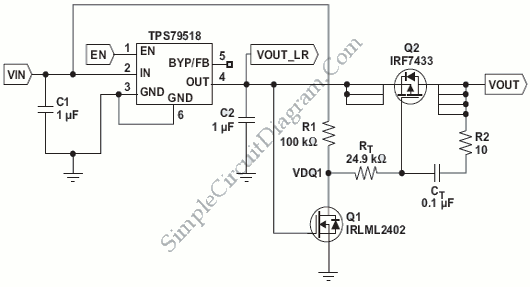
PMOS FET Following The Output for Soft Start Mechanism1 circuit schematic diagram

The selection component values should be highly considered because they have to meet the following requirements:
1.Q1 and Q2 must have a limit lower voltage than the desired output voltage (Vout > VTH1)
2.Q2’s rDS(on) must be small enough to make drop voltage not too high when the load draw high current

CT was chosen to be much larger than gate-to-drain capacitance (ie, CT>> CGD = Crss). RT selected according to the equation:

RT= (Vout-Vth)/(Ct*(Vout/tRise))

tRise: increase in the desired time (here 5ms)
V ^: Q2′s threshold voltage (0.9 V)
R1 is a pull-up resistor that has a large value
R2 should be chosen to be far smaller than RT.

[Source: Texas Instruments Application Notes]

This entry was posted in Power Supply and tagged . Bookmark the permalink.,

Possibly Related to "PMOS FET Following The Output for Soft-Start Mechanism" Circuits

  • Start Mechanism in Single Phase Induction Motor
    The single-phase induction motor is not self-starting device. The main winding carries an alternating current when the motor is connected to a single-phase power supply. A pulsating magnetic field will be produced by this current. The rotor is energized due … Continue reading →...
  • Basic FET Amplifier
    This is The Fet Amplifier circuit. This circuit uses FET transistor. The gate of the FET must be negative with respect to the source, so a bias can be achieved in the following manner. The voltage that is across the … Continue reading →...
  • FET Switch: A Voltage-Controlled Analog Switch
    This is a JFET switch circuit.This circuit uses a MPF102 JFET transistor. In this circuit, the JFET is symmetrical, so the input can be source or drain. The MPF102 is used because this transistor has gate’s reverse breakdown voltage of … Continue reading →...
  • 5V FET Voltage Regulator and How It Works
    Using a FET and two additional transistors (cascaded to improve the gain), a 5V FET voltage regulator can be formed. The additional Tr2 and Tr3 transistors will improve the output current handling and decrease the output impedance. The output voltage … Continue reading →...
  • Remote On-Off Switch through Small Transformer
    This is a remote on-off switch circuit. With this circuit, we can take the benefit of using small switch to control larger AC current from high power devices. Safer operation is the other benefit, since this circuit is control the … Continue reading →...

Comments are closed.