Low Power Regulator Reference

This is a simple circuit of low power regulator reference. This circuit can produces stable voltage reference. The voltage reference that is produced by this circuitĀ  almost free of supply voltage hash. This circuit has typical power supply rejection go over 100dB. Here is the circuit :
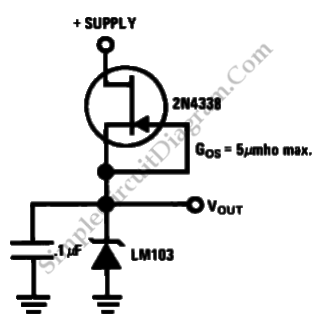
low power regulator reference circuit schematic diagram

[Source: National Semiconductor Application Note]

This entry was posted in Power Supply and tagged . Bookmark the permalink.,

Possibly Related to "Low Power Regulator Reference" Circuits

  • Low Voltage Adjustable Reference Supply
    Low voltage reference is important to provide offset source or biasing, or just a reference for comparator, and its adjustable feature should suit this circuit for many type of applications. [Source: National Semiconductor Application Note]...
  • Stabilized 3V Voltage Source/Reference
    This LM10 circuit can be used as low voltage low current voltage source or reference. This circuit regulate the voltage from the power supply to give a very stable output. TheĀ  minimum voltage level for powering this circuit require only … Continue reading →...
  • LM10 Shunt Regulator
    Shunt regulator is equivalent with zener diode regulator, where you can connect the circuit in series with a resistor and tap the output at the junction. With LM10, we can build more stable regulator (compared to zener diode version). Here … Continue reading →...
  • LM10 Current Regulator
    Current regulator acts like a load when connected to a voltage source, or in series between voltage source and real load. The main characteristic of a current regulator circuit is that it will try to keep the current flowing through … Continue reading →...
  • LM10 Negative Regulator
    It is possible to build a negative regulator using LM10 comparator and voltage reference IC. A transistor is employed to shift the reference current, increasing the minimum operating voltage to approximately 1.8V. The transistor should has high gain for better … Continue reading →...

Comments are closed.