L200 DC Motor Speed Control

This diagram tells us about how to use L200 device for the speed control of permanent magnet motors.
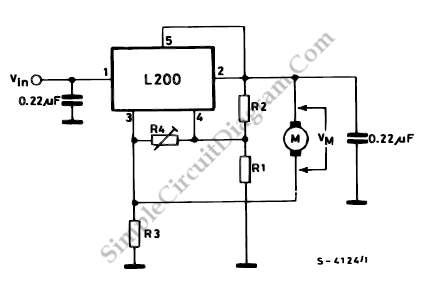
L200 DC Motor Speed Control circuit schematic diagram

By means of R1 and R2, we can obtain the desired speed, proportional to the voltage at the terminal of the motor.

Vm= Vref (1+R2/R1)

We can use this following equation to obtain better compensation of the internal motor resistance, which is essential for good regulation.

R3< (R1/R2).RM

This equation can be used with infinite R4. The motor speed can be increased without altering the ratio R2/R1 and R3 if R4 is finite. This voltage acts on R2 as a constant current source variable with r4 since R4 has a constant voltage (Vref) at it’s terminals, which does not vary as R4 varies. The voltage drop on R2 thus increases, and by the voltage at the terminals of the motor, the increase is felt. The voltage increase at the motor terminals is :

Vm = (Vref/(R4+R3)).R2

The circuit realization for 30 W motor (with  RM = 4 ohm) can be obtained using  R1 = 1 kohm, R2 = 4.3 kohm, R4 = 22 kohm and R3 = 0.82 ohm. [Source: STMicroelectronics Application Note]

This entry was posted in Control Electronics and tagged . Bookmark the permalink.,

Possibly Related to "L200 DC Motor Speed Control" Circuits

  • Constant Speed PWM Motor Control
    To make a constant speed motor control we can use Closed loop (servo) control. Constant speed motor is a motor that has constant speed although the load is change, indeed when the electric supply voltage is also changed. This circuit … Continue reading →...
  • F/V Converter in CLosed Loop Motor Speed Control System
    Closed loop or servo system has the ability to stabilize the controlled plant at a specified operating condition. The plant, the controlled sub-system, can be any form of controllable system. In motor control system, the plant is off course a … Continue reading →...
  • PWM Motor Speed Control Using Class D Audio Amplifier
    This is class D audio amplifier circuit that is used to control PWM motor speed. This circuit has two advantages for battery-powered portable devices. First, this circuit produces much less power dissipation than do it’s linear cousins. Second, it enhances … Continue reading →...
  • LM2907 Motor Speed Control – Part 2
    The following figure show us an alternative approach which gives proportional control. The charge pump integrator is shown in a feedback connection around the operational amplifier. For zero speed, the output voltage is equal to the reference voltage set up … Continue reading →...
  • LM2907 Motor Speed Control – Part 1
    We can purchase DC motors with or without brushes with ac tachometer outputs already provided by the manufacturer. A very low cost speed control can be constructed with these motors in combination with the LM2907. The most simple version is … Continue reading →...

Comments are closed.