Difference Amplifier Eliminates Vocal Track

Not only a summing circuits, but there are also subtracting circuits. Here’s the circuit diagram:
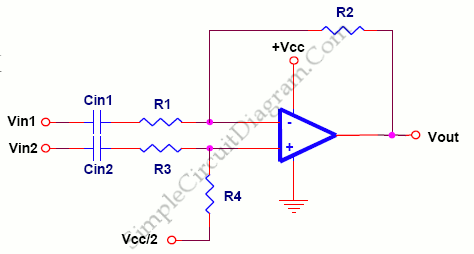
Difference Amplifier Eliminates Vocal Track circuit schematic diagram

Subtracting circuit is a common application which is used to eliminate the vocal track (recorded at equal levels in both channels) from stereo recordings.
R1 = R3 and R2 = R4,
Vout = (R2/R1)(Vin2 – Vin1)
R1||R2 = R3||R4
for minimum error due to input bias current.  [Source: Texas Instruments Application Note]

This entry was posted in Audio and Music, Signal Processing and tagged . Bookmark the permalink.,

Possibly Related to "Difference Amplifier Eliminates Vocal Track" Circuits

  • Single Supply Summing Amplifier for Audio Mixer
    The basis of an audio mixer is an inverting summing circuit below. For real audio mixers, a single-supply voltage is seldom used. To increase dynamic range, the designer will often push an op amp up to, and sometimes beyond it’s … Continue reading →...
  • Op-Amp Circuit: Difference Amplifier
    This is a circuit of difference amplifier. This circuit is an inverting amplifier that allows the subtraction of two voltages and that is the summing amplifier’s complement.This circuit also allows the the cancellation of a signal common to the two … Continue reading →...
  • Op-Amp Application: Inverting Amplifier
    The figure below show an operational amplifier circuit. Closed-loop gain given by this circuit is R2/R1 when this ratio is small compared with the amplifier open-loop gain, and it’s called as inverting circuit. The value of input impedance is equal … Continue reading →...
  • Op-Amp Application: Unity Gain Buffer
    This circuit is an Unity Gain Buffer. This circuit has a highest input impedance of any OP-AMP circuit. This circuit has a less gain error that is equal to common mode rejection or the reciprocal of the amplifier open-loop gain. … Continue reading →...
  • Op-Amp Circuit: Integrator
    This is a Op-Amp Integrator Circuit. This circuit is used to perform the integration operation. Essentially, this circuit is a low-pass filter with a frequency response decreasing at 6 dB per octave. This circuit should be equipped with an external … Continue reading →...

Comments are closed.