Op-Amp Application: Level Shifting Amplifier

Sometimes, in linear equipment design, it’s necessary to take a voltage which is referred to some dc level and generate an amplified output which is referred to ground. Using a differential amplifier similar to that shown in the circuit diagram below (the upper one) is the most straight-forward way of doing this. However, this circuit has a disadvantage, that is the signal source is loaded by current from the input divider, R3 and R4, and to prevent erroneous outputs from the common mode input signal the feedback resistor must be very well matched.

The other circuit diagram below (the lower circuit) doesn’t have the problems mentioned above. A voltage drop across the feedback resistor (R1) is generated by an FET transistor on the output of the operational amplifier which is the magnitude is equal to the input voltage. Here’s the circuit diagram:
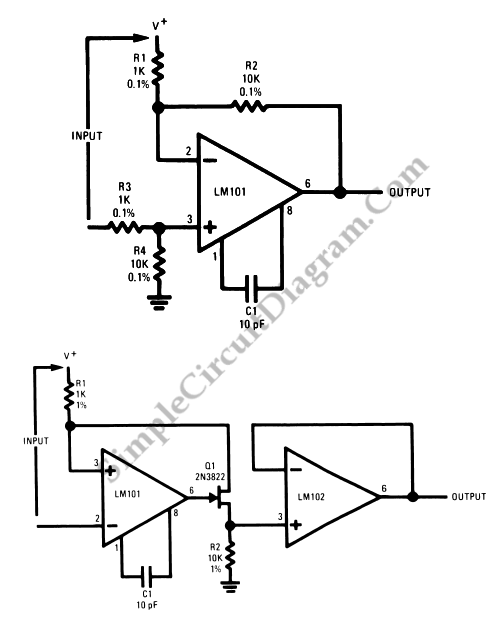
Op Amp Application Level Shifting Amplifier circuit schematic diagram

The input voltage multiplied by the ratio R2/R1 will be equal to the voltage across R2; and the common mode rejection will be as well as the amplifier basic rejection, independent of the resistor tolerances. LM102 voltage follower buffer this voltage to give a low impedance output.

The capability work with input voltages up to it’s positive supply voltages as long as the supplies are less than +- 15V is the advantage of LM101 in this circuit. [Source: National Semiconductor Application Note]

This entry was posted in Signal Processing and tagged , . Bookmark the permalink.,

Possibly Related to "Op-Amp Application: Level Shifting Amplifier" Circuits

  • Op-Amp Application: Unity Gain Buffer
    This circuit is an Unity Gain Buffer. This circuit has a highest input impedance of any OP-AMP circuit. This circuit has a less gain error that is equal to common mode rejection or the reciprocal of the amplifier open-loop gain. … Continue reading →...
  • Op-Amp Application: Inverting Amplifier
    The figure below show an operational amplifier circuit. Closed-loop gain given by this circuit is R2/R1 when this ratio is small compared with the amplifier open-loop gain, and it’s called as inverting circuit. The value of input impedance is equal … Continue reading →...
  • Micropower Single-Supply Instrumentation Amplifier
    A schematic diagram of a micropower single-supply instrumentation amplifier circuit is shown below. This circuit only need 15µA of current and can give over 110dB of common rejection. A single amplifier can provide differential to single-ended conversion with excellent common … Continue reading →...
  • Op-Amp Circuit: Difference Amplifier
    This is a circuit of difference amplifier. This circuit is an inverting amplifier that allows the subtraction of two voltages and that is the summing amplifier’s complement.This circuit also allows the the cancellation of a signal common to the two … Continue reading →...
  • Op-Amp Application: Non-Inverting Amplifier
    This is a high input impedance non-inverting circuit. This circuit provides a closed loop gain equal to (R1+R2)/R1. The close-loop 3 dB bandwidth of this circuit equal to the amplifier unity-gain frequency divided by the closed-loop gain. Here is the … Continue reading →...

Comments are closed.