Speed-Control for Small Asynchronous Induction Motor

On the circuit diagram below show us a schematic which is used to set the speed of a low-power induction motor, such as those which can be found in fan applications.

Noise coming from TRIAC commutations can be filtered using capacitors C1, C2 and C4. C2 has to be from X2 technology, whereas C1 and C4 capacitors have to be from Y2 technology. Here’s the circuit diagram:
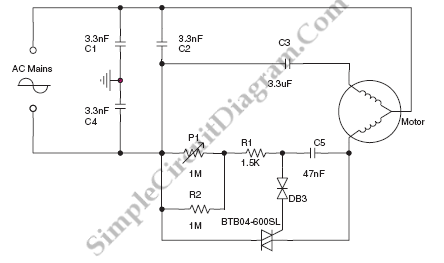
Synchronization across the TRIAC circuit schematic diagram

[Source: STMicroelectronics Application Note]

This entry was posted in Control Electronics and tagged . Bookmark the permalink.,

Possibly Related to "Speed-Control for Small Asynchronous Induction Motor" Circuits

  • L200 DC Motor Speed Control
    This diagram tells us about how to use L200 device for the speed control of permanent magnet motors. By means of R1 and R2, we can obtain the desired speed, proportional to the voltage at the terminal of the motor. … Continue reading →...
  • LM2907 Motor Speed Control – Part 2
    The following figure show us an alternative approach which gives proportional control. The charge pump integrator is shown in a feedback connection around the operational amplifier. For zero speed, the output voltage is equal to the reference voltage set up … Continue reading →...
  • Shaded-Pole AC Induction Motor
    A shaded-pole AC induction motor is one of type of AC induction motor that does not have start winding but has only one main winding. This type usually called “disposable motors because it better replace than repair. Besides cheap, the … Continue reading →...
  • LM2907 Motor Speed Control – Part 1
    We can purchase DC motors with or without brushes with ac tachometer outputs already provided by the manufacturer. A very low cost speed control can be constructed with these motors in combination with the LM2907. The most simple version is … Continue reading →...
  • PWM Motor Speed Control Using Class D Audio Amplifier
    This is class D audio amplifier circuit that is used to control PWM motor speed. This circuit has two advantages for battery-powered portable devices. First, this circuit produces much less power dissipation than do it’s linear cousins. Second, it enhances … Continue reading →...

Comments are closed.